I Wrote and Self-Published a Children’s Book in a Week Using Only Free Tools
Last week I had an idea about a dog. This week there’s an ISBN.
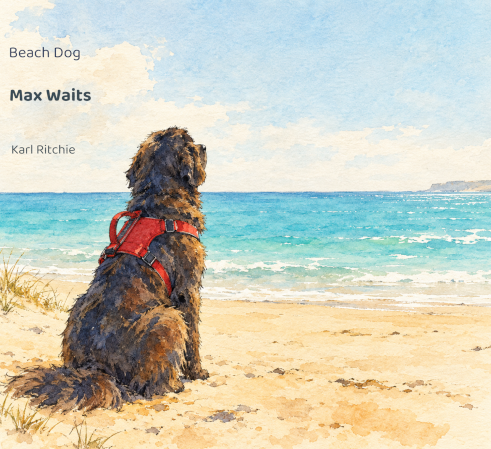
Max Waits is a picture book about a Newfoundland who works as a lifeguard on a beach. Every other dog on the sand is fetching, zooming, catching frisbees. Max just sits and watches the water. Everyone thinks he’s the laziest dog there — right up until the wind shifts.
It’s out now on Amazon. But the part I actually want to write about is how it got made, because I went in knowing nothing and the pipeline turned out to be more interesting than I expected.
The stack
Everything I used was free except the print cost:
- GIMP — scaling and prepping every image, plus the cover typography
- Scribus — page layout, 30 pages, PDF export
- Amazon KDP — print-on-demand, zero upfront cost
- AI image generation — all the illustrations
No InDesign, no Photoshop, no subscription. Total spend to get a live listing: nothing.
What actually went wrong
The resolution ceiling. My image generator capped at 1536 × 1024, and KDP wants 300dpi. On an 8 × 10 page that’s 2400 × 3000 pixels. I was short by more than half.
The fix was to stop fighting it — I framed every image inside a white border rather than running it to the page edge. Smaller image, fewer pixels needed, and as a bonus it gave the text a guaranteed clean place to sit instead of hunting for a quiet patch of sky on every page.
Then there’s the trim size trap. I built the whole thing as a 9 × 6 landscape book. KDP caps custom widths at 8.5 inches. Rebuilt it as 8.5 × 6 — and hit a 72-page minimum for that size. Rebuilt it again as 8 × 10 portrait. The lesson is to check the trim size constraints before laying anything out, not after.
On the AI illustrations
The pictures are AI-generated. I’ve declared that to Amazon, and I’m saying it here too.
I’d love to have commissioned a real illustrator, and if this one finds an audience that’s where the money goes next — a full picture book runs £2,000–5,000, which is real money for a first attempt at something I wasn’t sure I could finish. The writing is mine. The story structure, the pacing, every line of text. The pictures came out of a machine and I’m not going to pretend otherwise.
Worth knowing if you’re considering the same route: some retailers won’t stock AI-illustrated books, and the copyright position on AI output is unsettled in the UK. Go in with that understood.
What I learned about picture books
A few things that surprised me:
Picture book text is short. The whole book is under 500 words. My first draft of page one had three sentences describing a dog walking, and all three had to go.
Never write what the picture already shows. If the illustration shows a crowd cheering, the text saying “the crowd cheered” is dead weight.
The story structure is load-bearing in a way a novel’s isn’t. Fourteen spreads means fourteen beats, and you can’t waste one. Mine runs on a refrain — “Max waited” — that repeats until it breaks at the climax. That single line is doing most of the work.
The maths
Print cost £3.24 a copy. Listed at £8.99. KDP takes 40%, so I make about £2.15 per sale. Realistic expectation for a self-published picture book by nobody in particular: dozens of copies, not thousands. I made it because I wanted it to exist.
If you’ve got a kid between about 3 and 7, it’s here. There’s a note at the back about rip currents and what to do if you’re ever caught in one, which is the bit I’m most pleased about.
Comments (0)
No comments yet. Be the first!